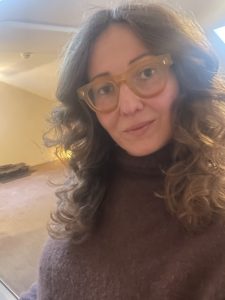
 Suhad Aljundi is a somatic practitioner who is currently completing her case study for the IBMT Diploma and is a second year of study in Somatic Experiencing. Here she writes about the power of the felt sense and how this came from her study of Embodied Anatomy & Movement Repatterning. She describes how training with IBMT connected her with a resource of power and strength, as well as themes of home and connection with land. She closes the piece by widening her view of what can be possible in the world and for those she works with.
Initiating movement from a particular body part and specifically from the felt sense of that body part is specific to somatics, and it was entirely new to me when I began my journey at IBMT. Before IBMT, most of my engagement with movement required an assembling of a few pieces together at the top-bottom cognitive level: a deliberate process linking will and determination with muscle strength, intellectual understanding, and a perception of my body’s spatial capabilities. And that movement originated rarely from within, from a deeper knowing of myself or who I am, it was always originating from who I wanted to be or from a pace that I assumed others wanted me to be in. That movement was never spontaneously formed as an emergent state of being inside my body, but rather from an adaptation that I wanted my body to meet.
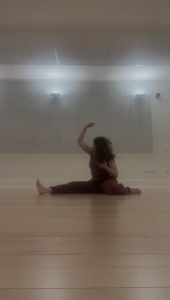
Moving from my felt sense came to life through IBMT work, visiting deeply every body system like a portal of its own to our internal processes and materials. I’ve had powerful experiences moving from different body systems and body parts but one practice that was incredibly powerful for me was moving from my coccyx. We were using a ball to sit on and we spent time orienting and connecting with the coccyx as a part of the endocrine system. As I tuned into the subtle energy of my coccyx, I found my pelvis, the entire container of bone, content and supporting organs began to move.
I let go of my guards, and a new movement unfolded into what felt like a state of power and creation that felt at the very core of my being. It was new, somehow unfamiliar, but felt welcomed. I felt connected to that sense of power of creation, a sense of birthing – be it a new thing, a project or a part of myself. The inner, subtle space of my body had become a reservoir of power and strength. It felt like a force that is needed for an inner and outer revolution, carrying an ancient wisdom essential for change and creation. I breathe and push to find my feet and the ground. My head and mouth moved towards my heart, then facing the deep connection to my anus, I breathe more fully. I feel a palpable pendulation in my spine, connecting me to solid ground and a life force moving throughout my body, expanding beyond my skin into space.
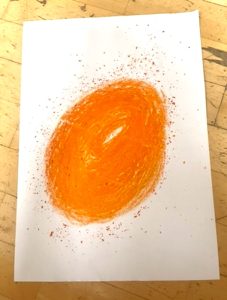
IBMT touched really deep places on my journey living on a new land and forced to be away from homeland. When I began the IBMT journey, I was immersed in a process of transition and movement both internally and externally. This movement came after a long period of stability and security in the UK, a period during which I had diligently gathered resources to feel safe on a land that is not my home. While this recent transition was significant, it was not my first; my initial move from Syria in 2011 required building new resources and relationships to adapt and settle. However, the movement I experienced just one year before starting IBMT “cracked me open,” demanding that I face the limitations of my previous survival strategies. My IBMT journey became my intentional and conscious process of re-connecting with my body, my needs, and a sense of home within and out – the homeland. Within my body, re claiming a sense of support and stability through the bones enabled mobility to move out into the world towards the mystery of the unknown.
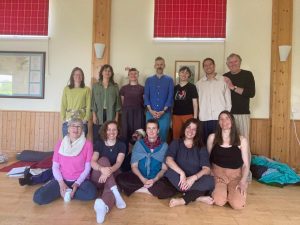
Words seem inadequate when it comes to describing how IBMT touched my life and my professional practice and how I relate to the world around me. But what I would like to share here as am committed to find words is how my personal journey seem to be weaved into and nurture my professional capacity to meet clients.
As I facilitate holding spaces for clients—individually and in groups—I recognise our journeys are part of a continuum. What I have nurtured and integrated within myself, I am safely and authentically able to meet and nourish in others. Recently, this practice has been vital in my explorations around systematic and social oppression.
I feel I am finally spreading my wings—moving more freely and less fearfully in the world. My commitment to conscious embodiment which is a lifelong journey is what fuel my energy on the day-to-day basis as I meet humans on their journey to healing and wellbeing. This process is my inner compass. As a somatic practitioner, this anchoring practice at its essence is at the core of how I meet my clients, a genuine curiosity and an openness to what might emerge in their process.
I am less focused on fixing and more interested in witnessing their direct experience in their moving or still body. This focused witnessing can help disrupt what is familiar, wounded, or limiting for them, opening the door to an awareness beyond the known. Ultimately, tissues and muscles will soften to include more and move beyond what has been familiar, wounded or disrupted for them in their lives. The beauty is in the journey.
Suhad Aljundi
www.somaticswithsuhad.com
https://open.substack.com/pub/somaticswithsuhad
Read other Student Articles Here